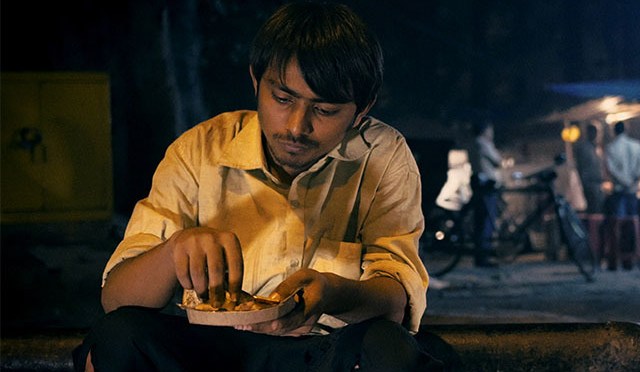
Piravi (Shaji N. Karun) India

Piravi
Shaji N. Karun
India.  110 min. 1988

Raghu is one of two children born to Raghava Chakyar and his wife. Born quite late in his parents’ marriage, Raghu is brought up with immense devotion and love until adulthood.

Now studying in an engineering college far from home, Raghu must return home for the engagement ceremony of his sister, but fails to turn up. His father Raghavan waits endlessly for his son to return. Raghavan takes daily trips to the local bus stop, waiting all day in the hope that Raghu will eventually come home. Soon it emerges, and the family come to know through newspapers, that Raghu has been taken into custody by the police for political reasons.

Raghavan sets out to try to find his son, and he eventually reaches police headquarters. However the police pretend not to know about Raghu, or his whereabouts, and furthermore, deny the fact that Raghu was taken into custody. Raghu’s sister eventually comes to the realization that her brother has probably died as a result of police torture, but hasn’t the heart to tell her father. Raghavan slowly begins to lose grip of reality and starts to dream of his family reuniting once more.

POSTER

Resultado de imagen de piravi shaji n karun

The Dispossessed (G. Aravindan) India

The Dispossessed
Govindan Aravindan
India. 103 min. 1990

The film is set in Calcutta. The story tells of Venu (Mohanlal), a Malayali officer in the rehabilitation ministry of the Andaman Islands, who selects candidates for a refugee aid programme enabling them to settle in the islands with state assistance. He meets an old Bengali widow (Mitra) who is not eligible for the programme, but he discovers that she is the abandoned wife of his uncle from Kerala. Re- establishing family links, he also befriends her hostile daughter (Gupta) and her son, a political refugee. Their brief acquaintance ends at a shipyard where he hoards his emigrant refugees on deck and leaves for the islands once more.

From its remarkable opening sequence, as the camera tracks through abandoned refugee shelters built during the 1943 famine and Partition, with a voice-over in Malayalam recapitulating that tragic history and the Kerala peoples’ commitment to the plight of the Bengalis, Aravindan makes clear his intention to transcend a localised and increasingly cynical view and to move towards something like a national perspective on the contemporary. In the process he also abandons much of his early pictorialism in favour of e.g. the remarkable shots of Mohanlal walking through the crowded Calcutta streets, or standing on the terrace of his cheap hotel, and especially in the last sequence aboard an ancient and grossly overcrowded ship overrun with impoverished refugees, as Venu tries to bring some order into the chaos. Several well- entrenched naturalist conventions, however, prevent a further formal elaboration of the style, such as the dialogue problems (Mohanlal speaks in Malayalam and English, Neelanjana Mitra in Bengali, highly accented Malayalam and English, and Neena Gupta only in English), but the acting is uniformly in tune with Joseph’s deliberately rough-edged camera.

GOVINDAN  ARAVINDAN

Resultado de imagen de govindan aravindan

(1935-91) Govindan Aravindan. Malayalam director, painter and cartoonist with an idiosyncratic style. Born in Kottayam, Kerala; son of the literary humorist, Govindan Nair. Worked as caricaturist for the Mathrubhoomi journal (1961-79), drawing the cartoon series Small Man and Big World, chronicling the adventures of Ramu, its corruptible proletarian hero, and Guruji; later did an occasional cartoon strip for the Kala Kaumudi journal, called A Bird’s Eye View.

His published cartoon collection (1978) highlights a change in drawing style in the early 70s, emphasising large blank spaces and characters almost disappearing below the frame.

His films are known for their distinctive look, sparse naturalism, silences and long shots with darker shades of grey in b&w films. Film society activist in Kottayam and Calicut. Early work was the only consistent cinematic manifestation of late 60s Calicut-based modernism represented particularly by artist Devan, the playwright and satirist Thikkodiyan and the writer Pattathiruvila Karunakaran (who produced Uttarayanam). A major influence on this group was the spiritualism of satirist and political activist Sanjayan. Later, like the visual artists associated with the Kerala Kalapeetam in Ernakulam, Aravindan combined this influence with the new, more mystical direction taken by K.C.S. Panicker’s (1911-77) paintings (cf. Kanchana Seeta).

His faithful producer and distributor, Ravindran of General Pics, ran a family business in cashew nuts. Worked at the Kerala Rubber Board throughout most of his film career. Also stage director, working in association with the playwright Srikantan Nair, after which he helped start the Navarangan (in Kottayam) and Sopanam theatre groups, staging e.g. Kali (1964) and Avanavan Kadamba (1976) using musical forms derived from the work of Kavalam Narayana Panicker, who later collaborated on the scripts of Kummatty and Estheppan. Noted actors associated with this group were Gopi and Nedumudi Venu. Also trained in the Kirana-style Khayal. Occasionally music director for other film-makers: Yaro Oral (1978), Piravi and Ore Thooval Pakshikal (both 1988).

Harvest time (Marina Razbezhkina) Russia

Harvest Time
Marina Razbezhkina
Russia. 67 min. 2004

In honor of Antonina’s hard work, the State rewards her with the prestigious Red Flag, also naming her the best tractor operator in the region. As the first woman to ever receive such title, Antonina becomes the source of great pride for her family and community. But when a mouse infestation threatens to destroy the valued Flag, the prestigious prize turns into a liability. Antonina becomes intensely invested in keeping it safe and at her home. More than a story of survival against ethics, or individuality against collectivity, HARVEST TIME is a piercing meditation on family unity. Set in the 1950s U.S.S.R., a period marked by rapid Soviet development and harsh poverty for its habitants, Razbezhkina’s film dares to combine humor and sensitive character development with a legitimate sense of nostalgia for a difficult and fascinating period in the Soviet past.

POSTER

Resultado de imagen de harvest time marina razbezhkina

CONTACT

Marina Razbezhkina :    razbmarina@yandex.ru

Holidays (Marina Razbezhkina) Russia

Holidays
Marina Razbezhkina
Russia.  52 min.  2006

The Mansi children on a boarding school in the small Russian village Ivdel are impatiently waiting for winter holidays. They are looking forward to return to their home village, where there is no television or video games. It takes a whole day to get to their hometown, through forests and snowed fields, but there is no place like home. At home they can ride sleigh, jump from the roof into the snow and play cards with grandmother. The winter break is a small change from the city life for the children. Will some decide to return forever?

Not my job (Denis Shabaev) Russia

Not My Job
Denis Shabaev
Russia. 70 min. 2015

The main character, the migrant worker Farrukh, lives in a trailer on the outskirts of Moscow together with his family – his father, mother and brothers – and has to take on any job that could earn him some money. But that is not the reason he left Tajikistan, his wife and small children. Farrukh wants to be an actor, a famous actor… Farrukh is swept into a whirlpool of conflicting circumstances – dreams of making it on the big screen, living the life of an illegal alien and the traditions of a Muslim family, which call on him to comply with the laws of the Quran. Some day Farrukh will have to make a choice.

DENIS  SHABAEV

Resultado de imagen de not my job denis shabaev

Denis Shabaev was born in 1980, in Moscow. In 2001-2003 he studied in the Gerasimov Institute of Cinematography, in the workshop for documentary film directors led by Igor Geleyn. In 2003-2010 he worked in cinema production and other spheres. In 2013 he graduated from the Marina Razbezhkina and Mikhail Ugarov School of Documentary Film and Theatre.

POSTER

Resultado de imagen de not my job denis shabaev

CONTACT

Marina Razbezhkina :    razbmarina@yandex.ru


Sindustan (Sapna Moti Bhavnani) India

Sindustan
Sapna Moti Bhavnani
India.  60 min.  2019

‘Who am I?’ and ‘Where do I come from?’ are questions that most of us inevitably ask ourselves at some point in our lives. Some of us learn about our roots by talking to our relatives, some of us read about history, some go on solo trips to better understand themselves. Sapna Bhavnani decided to make a documentary, and to represent her identity on her skin — through tattoos.

Bhavnani is a Bandra resident who has also spent a considerable part of her life in the US, but she traces her roots back to Sindh. Growing up, Sindhi culture for her was kadhi, and a mention in the national anthem. What puzzled her was that despite having a place in the anthem, this region wasn’t represented in the geography of the country. “We Sindhis are like magic, hum hai bhi, hum nahi bhi hai!”

SAPNA  MOTI  BHAVNANI

Sapna Bhavnani Sindhustan 825

Sniffer (Buddhadeb Dasgupta) India

Sniffer
Buddhadeb Dasgupta
India.  137 min.  2013

Anwar is a private detective working for a seedy agency specializing in hunting down cheating spouses and vetting potential mates for middle and upper class families. It’s his job to keep an eye on the prospective fiance(e)s and let the parents know if this is a suitably virginal match (most often it isn’t, this is 2014 after all). However, Anwar has a problem, it is the big beating heart in his chest that can’t quite seem to disconnect from his job when he’s undercover. He instinctively wants to protect true love from the harassment of arranged marriage, and it’s not good for business. As he finds himself falling deeper and deeper into cases, he ends up finding out that (surprise!) the intentions of his clients are less than noble and winds up on a journey to hunt down his own past and discover just how good a man he can be.

Director Buddhadeb Dasgupta is a multiple National Award winning Begali director with a CV going back nearly four decades, but this is the first of his films that I’ve seen. If this is the sort of work I’ve been missing, it’s definitely time to catch up. The combination of a filmmaker with such deep emotional bonds with his characters and India’s greatest character actor turned leading man in Nawazuddin Siddiqui is impossible to ignore, and the results are staggeringly heartfelt. Dasgupta treats his world with care, weaving himself in and out of his characters lives, delicately laying strands between them that will tie themselves into seemingly impossible knots that can only be undone with kindness, it is inspiring stuff.

DOWNLOAD PHOTOS

POSTER

CONTACT

IMAGINEINDIA INTERNATIONAL FILM FESTIVAL

The Flight (Buddhadeb Dasgupta) India

The Flight
Buddhadeb Dasgupta
India.  82 min.  2018

Bachchu Mondal is a car mechanic, but most importantly, he is a dreamer. His dream is a simple one, he just wants to fly, an aspiration he shares with his wife, but mostly his son, who actually enjoys his father’s attitude, since Bachchu behaves like a child (in a good way) quite frequently. Eventually, Banchu discovers the crash site of a World War II Japanese plane and decides to rebuild it, without, though, having any clue on how to accomplish that. Furthermore, the place the plane is lying is “inhabited” by ghosts, who have the tendency to share their life stories with our protagonist. While his wish brings him to Kolkata in search of parts, the authorities also begin to investigate him as a life threatening series of bizarre events conspire.

It’s certainly a far cry from the barbarism and stark violence of Dasgupta’s well-known The Wrestlers (Uttara), which won him best director kudos in Venice in 2000. Here, the violence lies within the hearts of people who can’t say no to their futile, dangerous desires, even though they are destroying their happiness. The Indians have been preaching the folly of being attached to worldly things for thousands of years, but evidently the lesson has not yet sunk in.


The Bait (Buddhadeb Dasgupta) India

The Bait
Buddhadeb Dasgupta
India.  87 min.  2016

Deep in the wilds of rural Bengal, eccentric faded aristocrat Raja is living in palatial splendor with his voluptuous mistress Rekha. But their relationship is clearly doomed. While he dances to crackly old songs played on a vintage vinyl turntable, she dreams of swimming off to faraway lands with mysterious strangers. Both appear stranded in antique fantasy versions of India, so it comes as a mild shock when a modern film crew arrive from Kolkata with their laptops and digital cameras, enlisting Raja to help them track down a tiger for a documentary project.

Meanwhile, not far away, former postman Goja has seemingly lost his mind and reinvented himself as a tree-dwelling soothsayer, gleaning sufficient clues from stolen mail to offer plausible-sounding prophecies to his gullible customers. And Munni  is a pre-teen nomad girl who earns a meager living for her impoverished lower-caste parents with her dazzling public displays of tightrope walking. All these narrative threads initially unfold separately, then cross and intertwine.

The Bait is based on a macabre short story by Narayan Bandyopadhyay, which Dasgupta first earmarked for adaptation over a decade ago, but which initially proved too blunt and spare for his maximalist magic-realist style. The film retains Bandyopadhyay’s shock final twist, which crystallizes one of many possible meanings of the title, but also fleshes out his blueprint text with extra characters and subplots.

BUDDHADEB  DASGUPTA

READ INTERVIEW TO BUDDHADEB DASGUPTA

POSTER

Resultado de imagen de the bait buddhadeb dasgupta


We, the people (Samarth Mahajan) India

We, the people
Samarth Mahajan
India. 28 min. 2018

“We, The People” explores dissent in India through protests on Jantar Mantar Road, a mile-long protest street in India’s national capital Delhi. Through three indefinite protests at Jantar Mantar Road, the film questions the socio-political reality of India vis a vis the ideals the nation set out with.

SAMARTH  MAHAJAN

Resultado de imagen de we the people samarth mahajan

Samarth Mahajan is a self-taught filmmaker passionate about telling stories from India that remain invisible to the mainstream. His documentaries have received critical and mass attention in media. “The Unreserved”, his national award-winning debut documentary, premiered at Film Southasia 2017 and has been screened in more than 50 national and international forums. “We, The People”, his documentary about India’s protest street Jantar Mantar Road, won multiple awards at Docedge Kolkata – Asian Forum for Documentary. He is currently directing “The Borderlands”, a documentary capturing human stories from India’s borders. Samarth completed his education from IIT Kharagpur and Young India Fellowship.

POSTER

Resultado de imagen de we the people samarth mahajan

CONTACT

Samarth Mahajan :  samarth.mahajan01@gmail.com