All posts by imagineindia

Anubrata Bhalo Achho? A tightly handed film of Partha Sen

Anubrata Bhalo Achho? / Are you ok Anubrata?
India. 2014. 103 min. Drama.
Director :   PARTHA SEN
Cast : Ritwik Chakraborty, Swastika Mukherjee, Debleena Dutta

Venue :  Centro Cultural Pilar Miró
21 may Thursday.  19.30

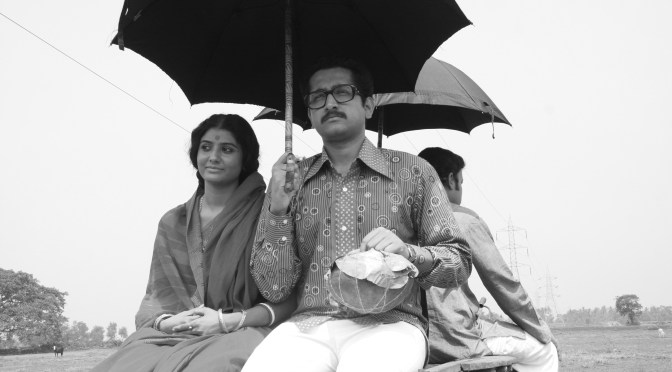
The film mainly delves into the daily routine of the protagonist, Anubrato- a man who has to go through the gradual process of his wife, Neeta’s suffering from cancer.
‘Anubrato- Bhalo Aacho?’ speaks of a solitary world that  Anubrato is surrounded by. His fight for his wife’s survival  brings him closer to the day to day struggle of life and death.

Continue reading Anubrata Bhalo Achho? A tightly handed film of Partha Sen

Csend és kiáltás (Silence and Cry)

Silence and Cry/Csend és kiáltás
Hungary. 73 min. 1968. Drama.
Director:   MIKLÓS  JANCSÓ
Cast:  Mari Töröcsik, József Madaras, Zoltán Latinovits.

Venue :  Spanish Film Institute
28 may Thursday.  20.00

Silence and Cry is set after the fall of the short-lived Hungarian Soviet Republic of 1919. A young Red soldier, fleeing the anti-Communist manhunt, takes refuge at the isolated farm of a peasant family. His reluctant hosts are already under police scrutiny for being political suspects.
The local White commander is aware of the soldier’s presence but, for personal reasons, keeps it a secret. The soldier discovers that the farmer is being poisoned, slowly, by his wife and her sister. As a personal war is waging within his own consciousness over morality and self-preservation, Istvan must decide whether to remain silent about the women’s devious secret and preserve his own life, or to report their heinous crime to the Royal Gendarme, which would also mean certain death for him.

Fényes Szelek (The confrontation)

Fényes Szelek
Hungary. 80 min. 1969. History.
Director:  MIKLÓS  JANCSÓ
Cast: Andrea Drahota, Kati Kovács, Lajos Balázsovits.

Venue :  Spanish Film Institute
29 may Friday.  21.40

This is Jancso’s first film in colour—muted, dusky colour punctuated by the vivid red of a boy’s shirt and of a streaming banner, with its suggestion of Hungarian bloodshed. It tells the story of protest and rebellion in 1947 Hungary where the Communist Party had taken power.

Szegénylegények (The round up)

Szegénylegények (The round up)
Hungary. 1966. 90 min. Drama.
Director :    MIKLÓS JANCSÓ
Cast : János Görbe, Zoltán Latinovits, Tibor Molnár.

Venue :  Spanish Film Institute
23 may Saturday.  19.30

In Hungary, the national movement led by Kossuth has been crushed and the Austrian hegemony re-established, but partisans carry on with violent actions. In order to root out the guerilla, the army rounds up suspects and jails them in an isolated fort. The authorities do not have the identity of the guerilla leaders, who are supposed to be present among the prisoners. However, they know enough about some of the suspects to apply perfidious forms of coercion effectively.

Csillagosok, katonák (The red and the white)

Csillagosok, katonák
Hungary. 1967. 90 min
Director:  MIKLÓS JANCSÓ
Cast:  József Madaras, Tibor Molnár, András Kozák.

Venue :  Spanish Film Institute
26 may Tuesday.  21.40

In 1919, Hungarian Communists aid the Bolsheviks’ defeat of Czarists, the Whites. Near the Volga, a monastery and a field hospital are held by one side then the other. Captives are executed or sent running naked into the woods. Neither side has a plan, and the characters that the camera picks out soon die.
A White Cossack officer kills a Hungarian and is executed by his own superiors when he tries to rape a milkmaid. At the hospital, White officers order nurses into the woods, dressed in finery, to waltz. A nurse aids the Reds, then they accuse her of treason for following White orders. Red soldiers walk willingly, singing, into an overwhelming force. War seems chaotic and arbitrary.

GAAV (The Cow)

Director :  DARIUSH MEHRJUI
Iran. 1969. 105 min.  Drama.
Cast :  Ezzatolah Entezami, Mahin Shahabi, Ali Nassirian.

Venue :  Función Lenguaje
29 may Friday.  20.00

The story begins by showcasing the close relationship between a middle-aged Iranian villager Masht Hassan and his beloved cow. Hassan is married but has no children. His only valuable property is a cow that he cherishes because it,s the only cow in the village. When Hassan must leave the village for a short time, the pregnant cow is found dead in the barn. Hassan’s fellow villagers fear his reaction and cover up the evidence of the death and tell him upon his return that his cow has run away. Having great difficulty dealing with the loss of his beloved cow, as well the loss of livestock that affects his social stature at the village, Hassan gradually goes insane following a nervous breakdown and he starts to belive he is the cow, adopting such mannerisms such as eating hay. His wife and the villagers try in vain to restore his sanity.

The Samanid prince Nooh ibn Mansur was reported to have thought that he was a cow. He was subsequently cured of his delusion by the medieval Persian physician Avicenna. It is possible that elements of the plot of The Cow were inspired by this.

Iran’s Ayatollah Khomeini was reported to have admired this film. This in turn was reported to have been the saving grace that allowed Iranian cinema to continue rather than it being banned after the Iranian Islamic Revolution.

AWARDS

OCIC Award – Recommendation – Forum of New Film 22nd Berlin International Film Festival 1972
FIPRESCI Prize 32nd Venice International Film Festival 1971
Best Actor Award Chicago International Film Festival 1971
Award for Best Screenplay Sepas Film Festival 1970

Penalty Corner

Penalty Corner
Ranjit Kumar Oraon
India. 2014. 23 min.

Venue :  Intermediae el Matadero
22 may Friday.  19.00

A poor tribal man, in the village of Jharkhand, struggle to sell his country poultry in village market where farm poultry has made in road, in order to buy a hockey stick and shoe for her daughter, Munuren. Meanwhile Munuren, with her younger brother, Prakash, has embarked on their journey in search of God in the forest who will bring their lost poultry back.

Ranjit Kumar Oraon

Bachelors of Technology in Chemical Engineering, Anna University, Chennai – 600024
Post Graduate Diploma in Film Direction, FTII, 2013

SARA

Director :  DARIUSH MEHRJUI
Iran, 1993. 102 min.
Adaptation of the work of Henrik Ibsen “A Doll’s House”.
Cast :  Niki Karimi, Yasman Malek-Nasr, Khosro Shakibai.

Venue :  Función Lenguaje
21 may Thursday.  21.00

Sara is the perfect young housewife. However, when husband Hessam requires an expensive emergency operation abroad, it is she who gets the funds. For the next three years Sara labours secretly to pay the shady loan and save Hessam’s pride… until the truth is revealed and, with it, the reality of her marriage.

The film is based on Henrik Ibsen‘s play A Doll’s House, with Sara in the role of Nora, Hesam in the role of Torvald, Sima in the role of Ms Linde and Goshtasb in the role of Nils Krogstad.

The movie won the Audience Award at the Nantes Three Continents Festival, and tied for the Golden Seashell at the San Sebastián International Film Festival, where Niki Karimi won Best Actress award (Silver Seashell) for the title role. And Yassamin Maleknasr Best Supporting Actress in Fajer Film Festival.

Sadabahar Brass Band

Sadabahar Brass Band
Tushar More
India.  2014.  27 min.

Venue :  Centro Cultural Pilar Miró
19 may Tuesday.  19.30

A court notice for an old building brings five brass band players together after a very long time. ‘Sadabahar Bras Band’ is the story of these performers reminiscing long lost purpose of their lives, before their beloved place turns into shambles.

Tushar More

Born on 5th May 1985, Tushar More after completing his Graduation in English, did his M.A in English Literature. He got into Film and Television Institute of India in 2010 and his debut short fiction film ‘Firdous’ premiered in Pune International Film Festival and also won Kodak Student Award.
‘Sadabahar Brass Band’ is Tushar’s Diploma Film for FTII Pune.