Black kite (Tarique Qayumi) Afganistan

Black Kite
Tarique Qayumi
Afganistan.  88 min.  2017

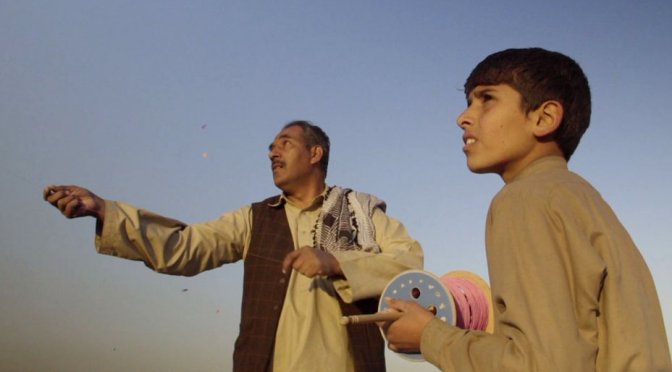
Five decades of political turmoil in Afghanistan are seen through the eyes of a hapless kite maker, the middle generation of a doomed dynasty.

Arian loves kites but a changing Afghanistan stands in his way. When the Taliban take power and ban kite flying, he all but gives up on his passion. However, to give his daughter Seema a sense of childhood that he once had, Arian risks his life to find and fly kites.

An Afghan refugee who emigrated to Canada before studying film at UCLA, writer-director Tarique Qayumi revisits his homeland’s tumultuous recent past with Black Kite. World premiering in Toronto, Qayumi’s second feature is an intimate family drama set against a widescreen historical canvas. It stars one of Afghanistan’s best-known actors, Haji Gul, and was partly shot in Kabul in low-key guerrilla style to avoid attracting unwelcome attention from the Islamist factions that still hold sway in parts of the country.

TARIQUE  QAYUMI

Resultado de imagen de black kite tarique qayumi

Tarique Qayumi was born in Afghanistan and went to Canada as a refugee in 1983. He graduate school at UCLA, where he completed his Screenwriting MFA. While in Afghanistan (2011- 2015) he wrote, directed and produced “Truth Unveiled”, Afghanistan’s first docudrama series; “The Defenders”, a drama miniseries, as well as Afghan “Sesame Street”. His first feature film, “Targeting” was directed in Los Angeles: a psychological-thriller about a female American soldier who returns home from war. “Black Kite” is his second feature: he wrote, directed, edited, and shot the film. He received both a grant from Canada Council for the Arts and as well the British Columbia Council for the Arts. “Black Kite” premiered at TIFF in 2017.

POSTER

Resultado de imagen de black kite tarique qayumi

Vellapokkathil (Jayaraj) India

Vellapokkathil
Jayaraj
India. 26 min. 2008

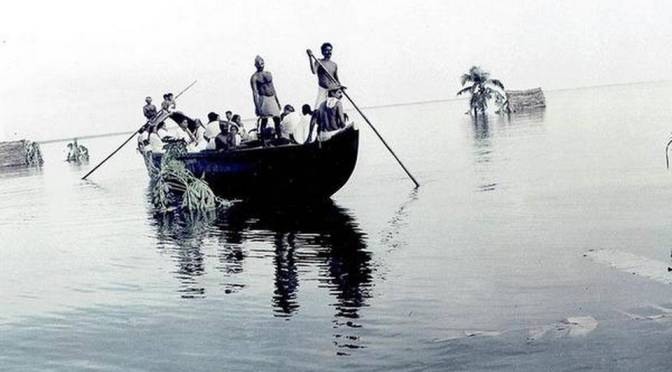
The flood that visited Kerala during 1928 was unprecedented and devastating. The actual events and experiences moved Thakazhi Siva Sankara Pillai to pen this story. This short film based on the above story brings out the beast in human beings set amidst the backdrop in Kuttanad. The same story relived before me when I saw the footage of the aftermath of a recent hurricane in America. What stood apart as a stark reality, unblemished by time and location, was the human character, ungratefulness ingrained in its very nature.

Bhayanakam (Jayaraj) India

Bhayanakam
Jayaraj
India.  125 min.  2018

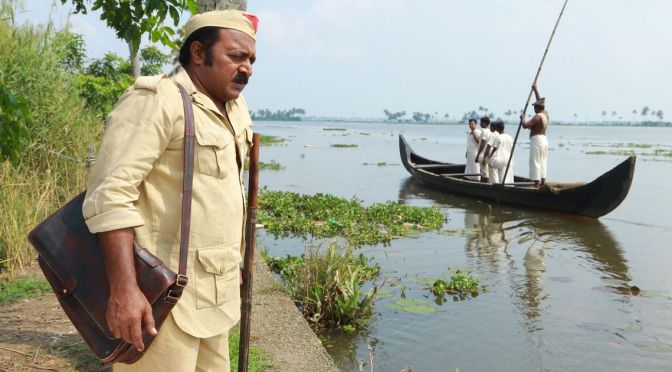
As the Second World War begins, a new postman takes charge in Kuttanad. The war intensifies and the postman whom the people had considered as a harbinger of good news turns out to be a messenger of death.

Bringing to mind Winston Churchil’s famous quip during the Second World war, ‘I have nothing to offer but blood, toil, tears and sweat’, the postman in Jayaraj’s Bhayanakam, who is a former soldier, is a relic of war with nothing else to offer but tearful memories of it. For the people of Kuttanad too, he has nothing to offer other than news of death. For them, the postman who was once the symbol of positivity and a good omen becomes a messenger of death and his bag carries the burden of war in the form of telegrams that breaks umpteen hearts and homes.

JAYARAJ

Resultado de imagen de bhayanakam jayaraj

Jayarajan Rajasekharan Nair, professionally credited as Jayaraj, is an Indian filmmaker, who predominantly works in Malayalam film industry. He is the founder of the Birds Club International and is actively involved in philanthropic work. Jayaraj is a recipient of the Crystal Bear Award at the Berlin International Film Festival, the Golden Peacock award at the IFFI , the Golden Crow Pheasant award at the IFFK , the FIPRESCI Award from the International Federation of Film Critics, the Don Quijote Award from the International Federation of Film Societies, The Network for the Promotion of Asian Cinema (NETPAC) award and a special mention award at the Karlovy Vary International Film Festival. He is also a 7 time recipient of the National Film Award and several Kerala State Film Awards. His notable films include, Desadanam (1996), Kaliyattam (1997), Karunam (2000), Shantham (2001), Daivanamathil (2005), Vellapokkathil (2007), Ottaal (2015), Veeram (2017) and Bhayanakam (2018).

POSTER

Resultado de imagen de bhayanakam jayaraj

Olu (Shaji N. Karun) India

Olu (She)
Shaji N. Karun
India.  109 min.  2018

The story of a girl Maya (Esther Anil), who is raped and discarded in the Kerala backwaters. She mysteriously survives underwater and is carrying a child. On full moon nights, she can see above water and on one such night, she sees a painter Vasu (Shane Nigam), as he is wandering the waters on his boat. An unsuccessful and uninspired artist, Vasu is struggling to create something spectacular in his paintings. Maya decides to help and empowers him to create a painting which changes his life. As Maya falls in love, she confronts Vasu’s contrasting ideas about love and realize that they seek different things from each other.

Set in a village, the film blends ancient beliefs, customs, religion, and mythology to create a densely layered film which engages on several counts. In imagining a different fate for its protagonist, melding her fate with that of a goddess, the film offers the woman an empowering choice instead of the one intended by her rapists.

The role of nature as the giver of life and beauty is foregrounded and intertwined with Maya, as nature finds primacy in the mythology of the goddess as well as in the creativity of the artist. The stunning choreography, a hallmark of Karun’s films, brings this unusual fantasy to life as the Kerala backwaters are created in exquisite detail.

Piravi (Shaji N. Karun) India

Piravi
Shaji N. Karun
India.  110 min. 1988

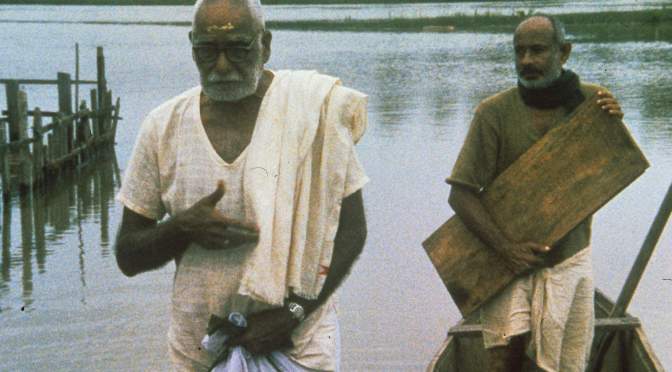
Raghu is one of two children born to Raghava Chakyar and his wife. Born quite late in his parents’ marriage, Raghu is brought up with immense devotion and love until adulthood.

Now studying in an engineering college far from home, Raghu must return home for the engagement ceremony of his sister, but fails to turn up. His father Raghavan waits endlessly for his son to return. Raghavan takes daily trips to the local bus stop, waiting all day in the hope that Raghu will eventually come home. Soon it emerges, and the family come to know through newspapers, that Raghu has been taken into custody by the police for political reasons.

Raghavan sets out to try to find his son, and he eventually reaches police headquarters. However the police pretend not to know about Raghu, or his whereabouts, and furthermore, deny the fact that Raghu was taken into custody. Raghu’s sister eventually comes to the realization that her brother has probably died as a result of police torture, but hasn’t the heart to tell her father. Raghavan slowly begins to lose grip of reality and starts to dream of his family reuniting once more.

POSTER

Resultado de imagen de piravi shaji n karun

The Dispossessed (G. Aravindan) India

The Dispossessed
Govindan Aravindan
India. 103 min. 1990

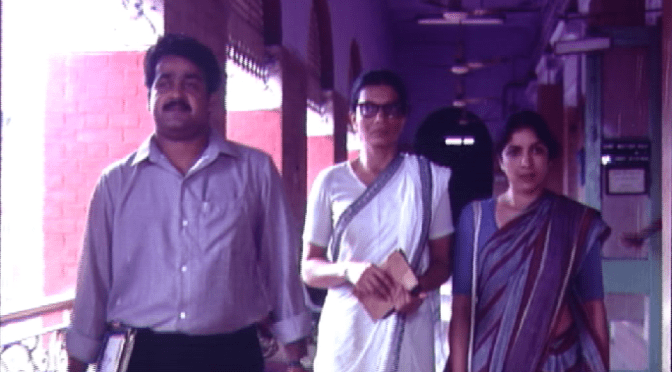
The film is set in Calcutta. The story tells of Venu (Mohanlal), a Malayali officer in the rehabilitation ministry of the Andaman Islands, who selects candidates for a refugee aid programme enabling them to settle in the islands with state assistance. He meets an old Bengali widow (Mitra) who is not eligible for the programme, but he discovers that she is the abandoned wife of his uncle from Kerala. Re- establishing family links, he also befriends her hostile daughter (Gupta) and her son, a political refugee. Their brief acquaintance ends at a shipyard where he hoards his emigrant refugees on deck and leaves for the islands once more.

From its remarkable opening sequence, as the camera tracks through abandoned refugee shelters built during the 1943 famine and Partition, with a voice-over in Malayalam recapitulating that tragic history and the Kerala peoples’ commitment to the plight of the Bengalis, Aravindan makes clear his intention to transcend a localised and increasingly cynical view and to move towards something like a national perspective on the contemporary. In the process he also abandons much of his early pictorialism in favour of e.g. the remarkable shots of Mohanlal walking through the crowded Calcutta streets, or standing on the terrace of his cheap hotel, and especially in the last sequence aboard an ancient and grossly overcrowded ship overrun with impoverished refugees, as Venu tries to bring some order into the chaos. Several well- entrenched naturalist conventions, however, prevent a further formal elaboration of the style, such as the dialogue problems (Mohanlal speaks in Malayalam and English, Neelanjana Mitra in Bengali, highly accented Malayalam and English, and Neena Gupta only in English), but the acting is uniformly in tune with Joseph’s deliberately rough-edged camera.

GOVINDAN  ARAVINDAN
Resultado de imagen de govindan aravindan

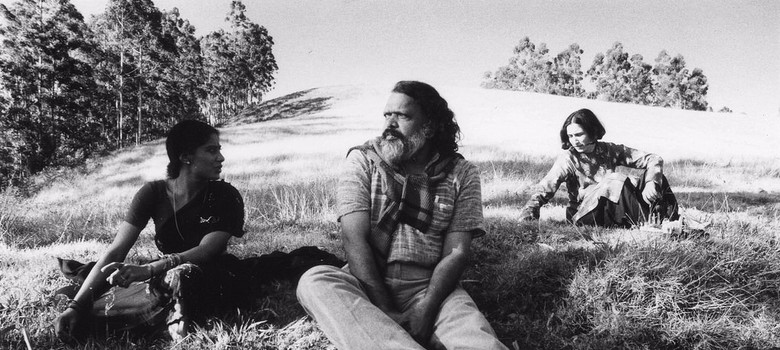
(1935-91) Govindan Aravindan. Malayalam director, painter and cartoonist with an idiosyncratic style. Born in Kottayam, Kerala; son of the literary humorist, Govindan Nair. Worked as caricaturist for the Mathrubhoomi journal (1961-79), drawing the cartoon series Small Man and Big World, chronicling the adventures of Ramu, its corruptible proletarian hero, and Guruji; later did an occasional cartoon strip for the Kala Kaumudi journal, called A Bird’s Eye View.

His published cartoon collection (1978) highlights a change in drawing style in the early 70s, emphasising large blank spaces and characters almost disappearing below the frame.

His films are known for their distinctive look, sparse naturalism, silences and long shots with darker shades of grey in b&w films. Film society activist in Kottayam and Calicut. Early work was the only consistent cinematic manifestation of late 60s Calicut-based modernism represented particularly by artist Devan, the playwright and satirist Thikkodiyan and the writer Pattathiruvila Karunakaran (who produced Uttarayanam). A major influence on this group was the spiritualism of satirist and political activist Sanjayan. Later, like the visual artists associated with the Kerala Kalapeetam in Ernakulam, Aravindan combined this influence with the new, more mystical direction taken by K.C.S. Panicker’s (1911-77) paintings (cf. Kanchana Seeta).

His faithful producer and distributor, Ravindran of General Pics, ran a family business in cashew nuts. Worked at the Kerala Rubber Board throughout most of his film career. Also stage director, working in association with the playwright Srikantan Nair, after which he helped start the Navarangan (in Kottayam) and Sopanam theatre groups, staging e.g. Kali (1964) and Avanavan Kadamba (1976) using musical forms derived from the work of Kavalam Narayana Panicker, who later collaborated on the scripts of Kummatty and Estheppan. Noted actors associated with this group were Gopi and Nedumudi Venu. Also trained in the Kirana-style Khayal. Occasionally music director for other film-makers: Yaro Oral (1978), Piravi and Ore Thooval Pakshikal (both 1988).