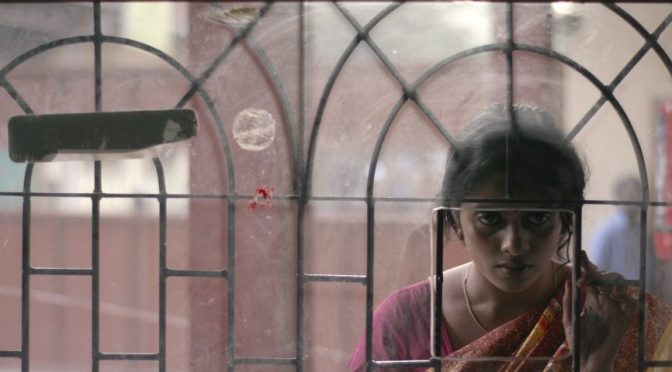
Counterfeit Kunkoo (Reema Sengupta) India. Imagineindia 2018

Counterfeit Kunkoo
Reema Sengupta
India. 2017. 14 min

Reema Sengupta’s film is India’s only short film entry at Sundance Film Festival in 15 years.

Counterfeit Kunkoo is unpretentious and realistic to its core. The film is about a separated single woman looking for accommodation in Mumbai and minces no words (or visuals) in underlining the desperation of her situation. With a satirical bent, the film showcases how women in India, even today, are expected to be accompanied by a man for finding a roof over their head. Says director Reema Sengupta, who wrote the film a few years back when her father asked her mother to find her own place after 24 years of marriage: “The idea was to address housing discrimination and the shift of attitude towards a woman after she decides to separate from an abusive marriage. I didn’t know how to channelise the deep sense of anger and helplessness I was feeling. So I chose to write a film about it.”

Javier Aguirresarobe (Jury) Imagineindia 2018

Obtained the diploma in Optics, initiated studies of Journalism. Later he entered the Official School of Cinema, where he coincided with Imanol Uribe, Ángel Luis Fernández and Julio Madurga, among others. He graduated in 1973.

His first feature was What does a girl like you in a place like this? by Fernando Colomo (1978). In his beginnings he worked a lot with Imanol Uribe and Montxo Armendáriz, which gave him great popular recognition in the Basque Country.

His consecration at the national level came from the hand of Alejandro Amenábar, with whom he collaborated in Los otros and Mar adentro. With Sea inside Oscar winner for the best foreign film of 2005, he won his sixth Goya award as director of photography. His professional career is plagued with multiple awards. This year also a compilation music video by Joaquín Sabina entitled Punto … y seguido.

In 2006 he made the film The Ghosts of Goya by Miloš Forman.

In 2007 he worked with Woody Allen in the movie Vicky Cristina Barcelona.

In 2009 he worked with John Hillcoat in the film The Road, based on the Pulitzer Prize novel by Cormac McCarthy.

In 2009 he worked as cinematographer with Chris Weitz on New Moon and with David Slade on Eclipse.

In 2013 he worked with Woody Allen in the movie Blue Jasmine.

Since 2007 he has been a member of Jakiunde, Academy of Sciences, Arts and Letters of the Basque Country.

Arturo Cardelús (Jury) Imagineindia 2018

Cardelús was born in Madrid, Spain in 1981. He studied at the Superior Conservatory of Music (Salamanca, Spain), Royal Academy of Music (London), Franz Liszt Academy of Music (Budapest), and Berklee University of Music (Boston).

In 2013, Cardelús attracted national attention for his composition Con Aire de Tango, which was commissioned by members of the Berlin Philharmonic after they saw a video of his work on YouTube / YouTube. Other pieces by Cardelús have been presented in venues such as the Auditorio Nacional de Madrid.

In 2012, Cardelús made music for the movie The Paperboy. In 2015, he made music for the Italian film Chiamatemi Francesco. Cardelús has also worked on independent Spanish and American films.

In 2016, Cardelús was elected Associate of the Royal Academy of Music (ARAM). In 2017, Cardelús made music for En un Heartbeat, a film that received universal praise for its animation, progressive message and emotional resonance.

Cardelús lives and works in Los Angeles.

Miriam Díaz Aroca (Jury) Imagineindia 2018

She was born on March 4, 1962 in Aranjuez, but grew up in Santander (Cantabria), growing up in the neighborhood of La Albericia. She studied journalism at the Complutense University of Madrid. She started working in Radio Minuto Fórmula de la Cadena SER, as an announcer and control technician.

Her first appearance on television was in the musical program Aplauso, in 1979, as a contestant in the section La juventud baila, presented by José Luis Fradejas being in third place behind Edel Bezanilla and the Madrid-born Rosa María Velasco, who won a prize of 25,000 pesetas. Professionally, she would debut with Javier Basilio in the contest Don Basilio’s boat, which was broadcast on the program of Jesús Hermida Por la mañana (1987-88). Later she went on to present a children’s program called Cajón desastre (1988-1991). She presented the contest of Un, dos, tres … together with Jordi Estadella (1991-1993).

Manhole (Vidhu Vincent) India. Imagineindia 2018

Manhole
Vidhu Vincent
India. 2016. 86 min

Manhole is a Malayalam movie directed by Vidhu Vincent depicting the life and struggles of a manual scavenger’s daughter. The film was adjudged the Best Film of the year 2016 by the jury for the Kerala State Film Awards 2016 and the Director of the film was selected as the Best Director of the year 2016. This made Vidhu Vincent the first woman to win the Best Director Award in the history of Kerala State Film Awards since its inception in 1969. According to jury chairman Apurba Kishore Bir, Manhole was the unanimous choice among the jury members for convincingly bringing the plight of the marginalised on screen.

The film was also chosen as one of the only two Malayalam films in the competition category of the International Film Festival of Kerala (IFFK) 2016. This has made Vidhu Vincent the first woman director to enter the competition section in the twenty-year history of IFFK. Manhole is the first feature film directed by Vidhu Vincent. The film also grabbed the FIPRESCI : Best Malayalam Film Award during the IFFK 2016. The film was selected for the award “for the raw reality with which the film sheds light on the persistent inhumanity of manual scavengers in India, despite its being legally banned, in a cinematically eloquent manner.”

Sand Castles (Akash Basumatari, Arjun Chavah, Maanvi, Priyamvada Jagia) India

Sand Castles
Akash Basumatari, Arjun Chavah, Maanvi, Priyamvada Jagia
India. 2015. 24 min

What is a ‘home’? Is it the same as a house? Or does it mean something else? Sand Castles or Raeton ka Mahal (2015) is a film that looks at homelessness in Mumbai through the eyes of people living on Girgaum Chowpatty. In the process of looking at ‘home’, the film discovers intertwining issues of sustaining livelihood, stereotypes about the poor, dignity and self-respect, ineffective laws and unreal demolitions in the city. When Tulsi Thakur, one of the many living in Girgaum Chowpatty is able to find a house, the questions assume another form, unravelling the unending struggle for a roof to live in the ever changing, harsh and liberating city of Mumbai.