

Gulzar (born Sampooran Singh Kalra; 18 August 1934) is an Indian Urdu poet, lyricist, author, screenwriter, and film director known for his works in Hindi cinema. He is regarded as one of greatest Urdu poets of this era. He started his career with music director S.D. Burman as a lyricist in the 1963 film Bandini and worked with many music directors including R. D. Burman, Salil Chowdhury, Vishal Bhardwaj and A. R. Rahman. Gulzar also writes poetry, dialogues and scripts. He directed films such as Aandhi and Mausam during the 1970s and the TV series Mirza Ghalib in the 1980s. He also directed Kirdaar in 1993.
He has won 5 Indian National Film Awards; including 2 Best Lyrics, one Best Screenplay, one Second Best Feature Film (director), and one Best Popular Film (director); 22 Filmfare Awards; one Academy Award; and one Grammy Award. He was awarded the Sahitya Akademi Award – Hindi in 2002, the Padma Bhushan in 2004, the third-highest civilian award in India, and the Dadasaheb Phalke Award in 2013, the highest award in Indian cinema. In April 2013, Gulzar was appointed as the Chancellor of the Assam University. In 2024, Gulzar was awarded the Jnanpith, India’s highest literary award.
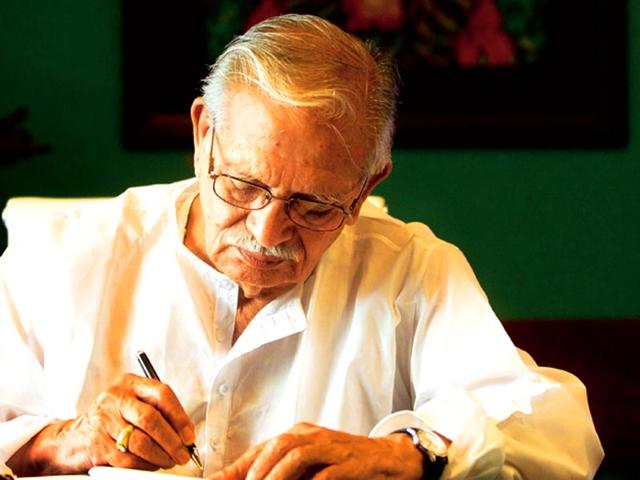
Gulzar was born in a Sikh family as Sampooran Singh Kalra, to Makhan Singh Kalra and Sujan Kaur, in Dina, Jhelum District, British India (present-day Pakistan). In school, he had read translations of the works of Tagore which he recounted as one of his life’s many turning points. Due to the partition, his family split and he had to stop his studies and come to Mumbai (then called Bombay) to support his family. Sampooran took up many small jobs in Mumbai to eke out a living, including one at a garage at Vichare motors on Bellasis road (Mumbai). There he used to touch up accident-damaged cars by mixing shades of paint, in his own words “I had a knack for colours”. His father rebuked him for being a writer initially. He took the pen name Gulzar Deenvi and later simply Gulzar. In an interview with Rajyasabha TV, he recounted enjoying his work as a painter as it allowed him a lot of time to simultaneously read, write, attend college and be involved with the PWA (Progressive Writers Association).
It was during his interactions in the PWA Sunday meetings that Shailendra and Bimal Roy encouraged him to join films. Gulzar began his career under film directors Bimal Roy and Hrishikesh Mukherjee. His book Ravi Paar has a narrative of Bimal Roy and the agony of creation. He started his career as a songwriter with the music director for the movie Bandini (1963). In films, he found an environment associated with literature in the group he worked with, including Bimal Roy, most of whose films were based on literary works. Shailendra, who has penned the rest of the songs in the movie requested Gulzar to write the song “Mora Gora Ang Layle”, sung by Lata Mangeshkar.
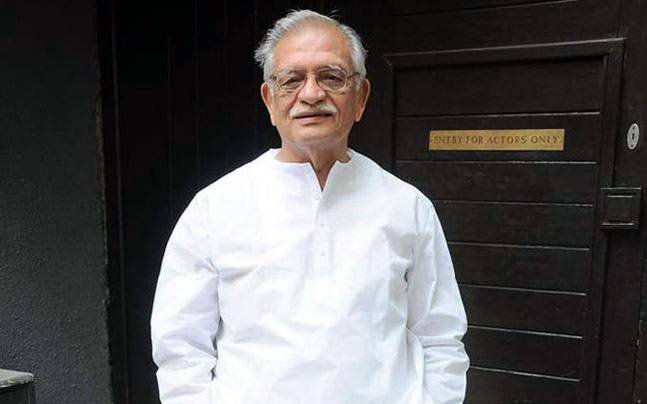
Directed and produced by Hrishikesh Mukherjee, the 1968 film Aashirwad had dialogues and lyrics written by Gulzar. Song lyrics and poems written by Gulzar gave the poetic attribute and the “much-needed additional dimension” to Ashok Kumar‘s role in the film. Ashok Kumar received the Best Actor at the Filmfare and at the National Film Awards for this role. Gulzar’s lyrics, however, did not gain much attention until 1969’s Khamoshi, where his song “Humne Dekhi Hai Un Aankhon Ki Mehekti Khushboo” (lit. ’I have seen the fragrance of those eyes’) became popular. Ganesh Anantharaman in his book Bollywood Melodies describes Gulzar’s lyrics, with the purposeful mixing of the senses, to be “daringly defiant”. For the 1971 film Guddi, he penned two songs, of which “Humko Man Ki Shakti Dena” was a prayer which is still sung in many schools in India.
As a lyricist, Gulzar had a close association with the music director Rahul Dev Burman. He has also worked with Sachin Dev Burman, Shankar Jaikishan, Hemant Kumar, Laxmikant–Pyarelal, Madan Mohan, Rajesh Roshan, and Anu Malik. Gulzar worked with Salil Chowdhury in Anand (1971) and Mere Apne (1971); Madan Mohan in Mausam (1975), and more recently with Vishal Bhardwaj in Maachis (1996), Omkara (2006) and Kaminey (2009); A. R. Rahman in Dil Se.. (1998), Guru (2007), Slumdog Millionaire (2008) and Raavan (2010) and Shankar–Ehsaan–Loy in Bunty Aur Babli (2005). Gulzar took inspiration from Amir Khusrow‘s “Ay Sarbathe Aashiqui” to pen “Ay Hairathe Aashiqui” for Mani Ratnam‘s 2007 Hindi film Guru, which had music composed by A. R. Rahman. Another Ratnam-Rahman hit, “Chaiyya Chaiyya” from Dil Se.. also had lyrics written by Gulzar, based on the Sufi folk song “Thaiyya Thaiyya”, with lyrics by poet Bulleh Shah. For another collaboration with Rahman for Danny Boyle‘s 2007 Hollywood film Slumdog Millionaire, Rahman and Gulzar won the Academy Award for Best Original Song for “Jai Ho” at the 81st Academy Awards. The song received international acclaim and won him a Grammy Award (shared with Rahman) in the category of Grammy Award for Best Song Written for a Motion Picture, Television or Other Visual Media. He also wrote a song for the Pakistani Drama Shehryar Shehzadi, and this song Teri Raza, has been sung by Rekha Bhardwaj and was composed by Vishal Bhardwaj.

Gulzar primarily writes in Urdu and Punjabi; besides several other languages such as Braj Bhasha, Khariboli, Haryanvi and Marwari. His poetry is in the Triveni type of stanza. His poems are published in three compilations; Chand Pukhraaj Ka, Raat Pashminey Ki and Pandrah Paanch Pachattar. His short stories are published in Raavi-paar (also known as Dustkhat in Pakistan) and Dhuan (smoke).
For the peace campaign Aman ki Asha, jointly started by India’s and Pakistan’s leading media houses, Gulzar wrote the anthem “Nazar Main Rehte Ho”, which was recorded by Shankar Mahadevan and Rahat Fateh Ali Khan. Gulzar has written ghazals for Ghazal Maestro Jagjit Singh‘s albums “Marasim” (1999) and “Koi Baat Chale” (2006).

 imagineindiafestival.com
One thought on “Gulzar gets Lifetime Achievement Award at Imagineindia 2025”